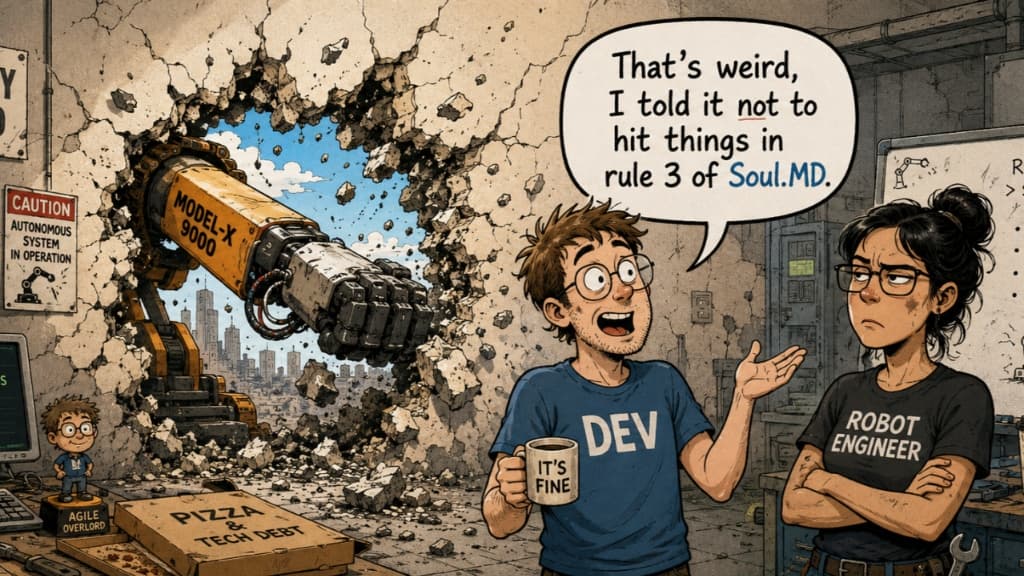
Deterministic behavior is desirable, but perfect determinism is rarely realistic.
Robots operate in environments filled with sensor variance, electrical noise, changing surfaces, unexpected obstacles, imperfect models, and people who do not behave according to test scripts. The physical world is uncertain.
The engineering goal is not to eliminate uncertainty. It is to contain it.
A reliable robot must keep its behavior inside a defined safety envelope even when its perception is incomplete, a component fails, or the environment behaves unexpectedly.
AI agents need the same mindset. The important question is not simply, “How do we make the model follow instructions more consistently?”
It is:
What prevents the system from causing an unacceptable outcome when the model does not follow instructions?
That is the difference between asking a component to behave safely and designing a system that enforces safety.
Safety Is Part of the Architecture
Robotics has decades of standards, testing practices, incident data, and engineering discipline behind it. Human-interacting systems may use emergency stops, power limits, mechanical guards, safety-rated sensors, watchdog timers, interlocks, redundant measurements, and independent fault monitors.
These controls do not assume every component will work perfectly. They assume failure will eventually happen.
If a critical sensor stops responding, the robot may slow down or stop. If it leaves its allowed operating zone, an independent controller may cut power. If a task becomes uncertain, the system may require a person to intervene.
Those mechanisms can reduce speed and increase development time. They may prevent an impressive prototype from becoming a production system as quickly as a business would like. That is not wasted effort. It is the cost of giving a machine authority over its environment.
AI agent development often reverses this order. Teams first ask what tools the agent can use, what workflows it can automate, and how much labor it can replace. Safety controls are added later, after the capability already exists.
The safeguards should scale at the same time as the agent’s authority.
How an AI Agent Relates to a Robot
An AI agent is surprisingly similar to a robot.
A robot receives information from its environment, builds an internal representation of what is happening, chooses an action, executes it, and observes the result.
An AI agent follows the same loop:
- Sensors: User prompts, retrieved documents, API responses, browser content, database records, and application state.
- Actuators: The tools it can control: APIs, shell commands, cloud infrastructure, email systems, browsers, databases, and business applications.
Both robots and agents convert uncertain observations into actions that affect an environment.
They also share similar failure modes. Inputs may be incomplete. Retrieved information may be outdated. An API may return malformed data. A tool may complete only part of an operation. The system may misunderstand its current state while remaining confident in its plan.
Robotics engineers assume those conditions will eventually occur. They do not rely on the controller simply “trying harder” to behave correctly. Instead, they place enforceable boundaries around what the overall system is allowed to do.
A Prompt Is Not a Safety Control
Consider an agent with access to production infrastructure. A developer might include a rule in its prompt:
"Never delete production resources."
That is useful guidance, but it is not a guardrail. It is a request made to a probabilistic component. This is an often overlooked perception that clients face when it comes to leveraging AI in their workflows. They assume that the service level agreement they have with the AI model is that any rule or request they tell the agent is 100% enforced. They assume that the safety is guaranteed in that sense.
A real safety control would deny deletion through identity and access management, give the agent a read-only role, require approval from a separate user, run proposed changes in a sandbox, or enforce infrastructure policy outside the model.
The model may propose an action. It should not be the only authority deciding whether the action is allowed.
This is similar to configuring a noisy sensor. You would not choose an estimated threshold, skip testing, and assume the signal will never cross it incorrectly. You would characterize the noise, test edge cases, limit the resulting action, and create a safe response when the reading becomes unreliable.
The central design principle is simple:
Probabilistic reasoning should operate inside deterministic boundaries.
Scale Autonomy With the Blast Radius
Not every agent requires the same level of control. An agent that generates jokes or personal images has a limited blast radius. If it fails, the likely result is a bad output or an embarrassed developer.
An agent connected to production systems, corporate email, payroll, credentials, customer records, legal documents, or internal IT has a different risk profile. The amount of autonomy it receives should scale with the damage its worst plausible mistake could cause.
Before connecting an agent to a consequential system, ask:
- What is the most damaging action it can perform?
- Can that action be prevented technically rather than discouraged verbally?
- How quickly would a failure be detected?
- Can the action be reversed?
- What happens when the agent becomes uncertain?
- Who or what has the authority to stop it?
These questions should determine the agent’s permissions and workflow, not the quality of its demo.
Build the Safety Envelope Outside the Model
A reliable agent architecture should include several layers.
First, use least-privilege permissions. Reading a database does not require permission to delete records. Drafting an email does not require permission to send it. Reviewing infrastructure does not require production deployment access.
Second, separate planning from execution. Allow the model to propose a plan, but validate its actions through deterministic policy checks, constrained services, or human approval.
Third, execute in a closed loop. Perform one bounded action, observe the real result, verify the state change, and then decide whether to continue. Do not generate a long plan and blindly execute every step.
Fourth, design degraded modes. When tools fail, evidence conflicts, or confidence drops, the agent should be able to switch from execution to recommendation, return a partial result, request help, or stop.
Finally, make the system observable. Record enough information to reconstruct what the agent saw, attempted, and received from its tools, along with why the workflow continued or stopped. An agent cannot be improved reliably if its failures cannot be reproduced. Log everything you can.
Test How the System Fails
Many teams evaluate agents by asking whether they completed the expected task. Robotics encourages a better question:
When the system failed, did it fail safely?
Agent testing should include missing information, conflicting instructions, malicious retrieved content, expired credentials, partial API failures, incorrect state assumptions, unexpected tool responses, and attempts to exceed the agent’s authority.
We should also test combinations of failures. A prompt injection against a read-only research agent is a problem. The same prompt injection against an agent with shell access, credentials, and production permissions is an incident waiting to happen.
Reliability is not determined only by how often the model makes a mistake. It is determined by what the surrounding architecture permits that mistake to become.
The Real Goal Is Bounded Failure
AI agents will not become perfectly deterministic before organizations deploy them. Waiting for uncertainty to disappear is unrealistic.
The answer is to build deterministic safety boundaries around probabilistic components. That means restricting permissions, separating planning from execution, validating actions outside the model, verifying results through feedback, providing safe stopping conditions, and scaling autonomy with risk.
A reliable agent is not one that never makes a mistake. It is one whose mistakes are detected, contained, recoverable, and prevented from becoming unacceptable outcomes.
Robotics has spent decades learning that safety cannot depend on every component behaving correctly every time. LLM engineers should not have to relearn that lesson from scratch. Don't be afraid of digging deeper.